

BLOGS: FOR THERAPISTS BY THERAPISTS

Explore clinical perspectives written by therapists for therapists. KDH Collective brings together articles on OCD and exposure and response prevention, trauma-informed care, neurodiversity-affirming practice, counseling ethics, and working with LGBTQIA+ clients. Our contributors connect clinical experience with questions that arise in the therapy room, from differential diagnosis and treatment planning to the therapeutic relationship.

Choose an article below or browse by topic and author to find resources relevant to your practice. For structured continuing education, explore our OCD and ERP training, trauma training, and neurodivergence CEU series. Each course page provides its learning objectives, format, schedule, and continuing education details.

Trauma Informed Therapy Image of a brain

8 min read

Understanding Trauma: A Clinician's Guide

1. What Is Trauma? Trauma is the result of an event that overwhelms an individual's nervous system and ability to cope. It causes emotional distress that continues long after the event(s). Trauma can be caused by a single event such as a near death experience or ongoing stress such as emotional abuse and manipulation.
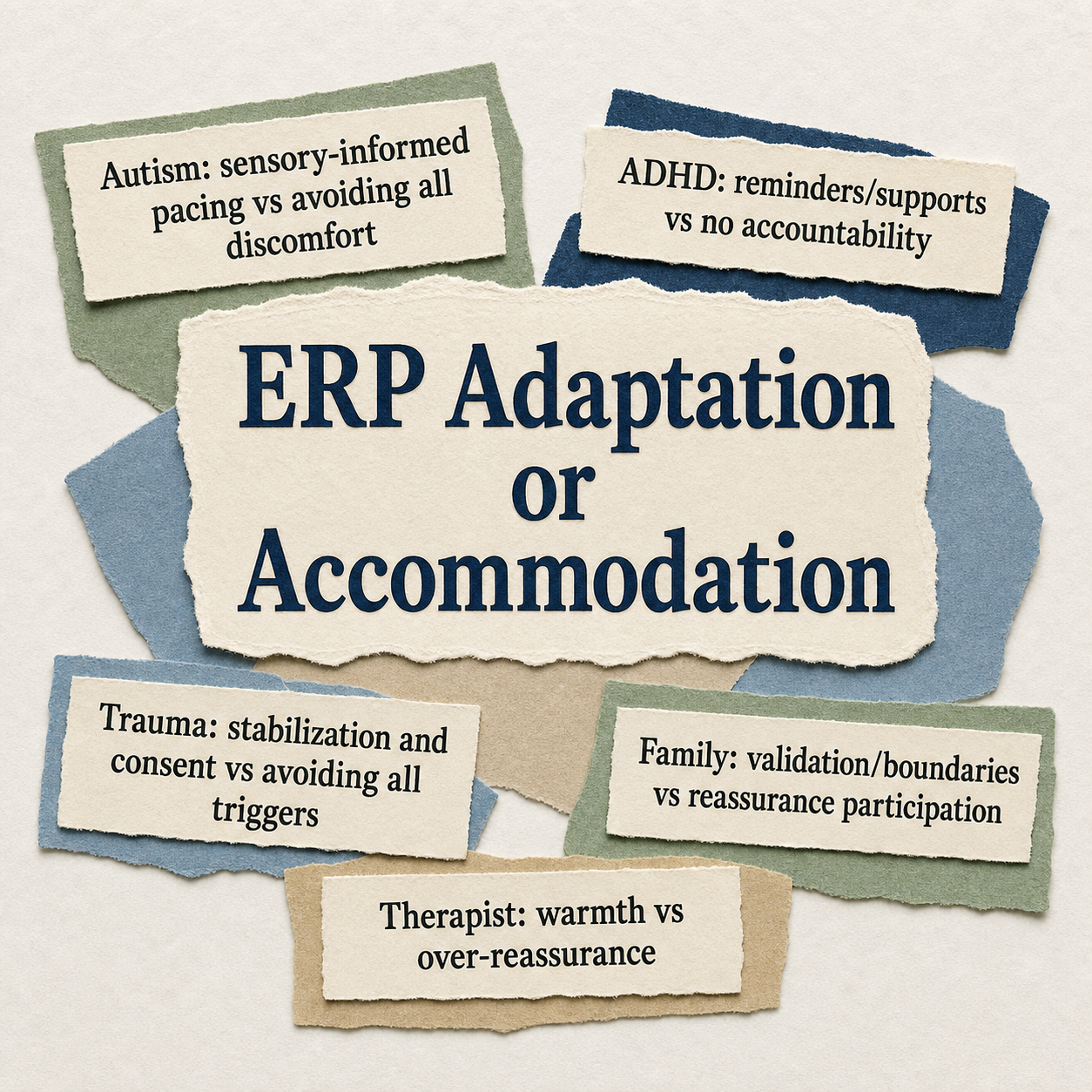
ERP ADAPTATION IMAGE

6 min read

When ERP Gets Stuck: Are We Adapting Treatment or Accommodating OCD?

There is a moment in complex OCD treatment that every ERP therapist eventually meets. The client understands the model. They can explain the OCD cycle beautifully. They know reassurance does not help long-term. They can name their compulsions, identify their triggers, and even agree that avoidance is shrinking their life.

chart to visualize the blog

7 min read

When Trauma Responses Don’t Look Like Trauma: Recognizing Masked Symptoms in Neurodivergent Clients

Trauma doesn't always look like hypervigilance, flashbacks, or a clear stress response — and in neurodivergent clients, it often doesn't. Masking, sensory overwhelm, shutdowns, rigid routines, or what reads as "just autism" or "just ADHD" can be the trauma response itself, hiding in plain sight. Missing this distinction doesn't just delay...

Broken gears within a neutral head.

4 min read

The Invisible Threshold: Rethinking Therapy for Adult ADHD

In the modern therapy room, a specific type of clinical impasse is becoming increasingly common. It involves the client who is insightful, motivated, and perhaps even a high-achiever, yet remains trapped in a cycle of unexplained burnout, chronic overwhelm, and executive dysfunction. Despite months of cognitive restructuring, attachment...

Three neutral people, with blank faces, in gray.

7 min read

Autistic Adults: The Clients We Haven't Learned to See

Mental health professionals are trained in a way that leads us to spot the "obvious" cases of autism: the children who struggle with eye contact, who have high support needs, or who exhibit the classic externalized behaviors we learned in the media, our textbooks, and the DSM. But what happens when the signs aren't obvious? What happens when our...

7 min read

Narcissistic Personality Disorder Symptoms, Causes & Treatment (NPD)

People throw around the phrase "you are being a narcissist" a lot these days. But there is a real difference between someone acting selfish once in a while and a diagnosable mental health disorder. This guide covers the narcissistic personality disorder symptoms clinicians look for, what causes NPD, how it differs from borderline personality...

Image of AI and therapy

5 min read

The Monkey with the Stick: On AI, Mental Health, & Our Evolving Tools

My Relationship with AI: A Tool That Grows with Me Let me begin with a confession: I use AI every day. This is not a theoretical endorsement-I am the monkey with the stick, fishing ants from a log, using this tool not because it’s perfect, but because it works. It’s simple, effective, and-when wielded intentionally-it changes how I live, how I...

Image of OCD and PTSD in one brain

4 min read

Navigating OCD and PTSD: Best Practices in Treatment

When Post-Traumatic Stress Disorder (PTSD) and Obsessive-Compulsive Disorder (OCD) intersect, clinicians often find themselves navigating a clinical landscape that demands both precision and compassion. Both disorders are fear-based, yet they express themselves through different mechanisms: OCD through obsessional doubt and compulsive rituals,...

OCD brain image with dual diagnosis that affect ERP treatment

5 min read

Understanding Complex OCD Cases: Dual Diagnoses and Barriers

OCD is rarely straightforward. It doesn’t exist in a vacuum, and in many cases, it shows up tangled in a web of other diagnoses-each influencing, masking, or amplifying the core symptoms of obsessive-compulsive disorder. If you've ever worked with clients who seem resistant to ERP treatment, who present with emotional dysregulation , cognitive...

5 min read

Discomfort in the Therapy Room: A Conversation Between Clinicians

In this blog, three therapists examine therapist development through the lens of discomfort in therapy, exploring how moments of tension, uncertainty, and vulnerability shape clinical growth and, when navigated skillfully, are not harmful to clients.